“I want to know what’s been left out” is a reasonable place to begin a detergent enquiry. It becomes less useful if you end up guessing at everything else. In the Jielions Camellia Perfume Laundry Detergent description, you’ll find “No Fluorescent Agent,” “No Phosphorus” and “gentle fabric care,” attached to a 5kg perfume detergent. Before choosing it, separate those descriptions. A question about brighteners isn’t answered by the fragrance name, and the fragrance isn’t explained by an ingredient exclusion.
What is the “optical” part of brightening?
The alternative name “fluorescent whitening agent” provides a clue. These dyes fluoresce blue-white under ultraviolet light, an effect that can make yellowed fabric appear whiter. This explanation comes from the European Commission Joint Research Centre’s technical discussion of detergent ingredients. It concerns the appearance of the fabric in light, rather than a measurement of how much dirt a wash removed.
For example, you could look at a washed shirt and ask two questions: “Does it look whiter?” and “Did the mark come out?” The optical effect explains an aspect of the first. For the second, you’d still inspect the area you wanted to clean.
There is no complete answer to either question in an ingredient-exclusion phrase. You may have ruled a particular ingredient out and still have an open question about the washing. A sample evaluation gives you a way to address that question for the proposed detergent instead of deciding on the phrase alone.
What exactly are you asking Jielions to confirm?
There are two pieces of wording to put side by side: “No Fluorescent Agent” from the listing and the optical-brightener exclusion in your purchasing brief. Making the connection explicit is preferable to assuming that a supplier will interpret the brief in exactly the same way you do.
One possible enquiry would be: “Please confirm that the Camellia version you’re quoting meets our requirement to exclude optical brighteners. We’re referring to the fluorescent-agent wording on your page.” A reply about an identified formula is more useful than agreement about a general term.
Which other preferences are on your shopping list?
Suppose you’ve written down “no optical brighteners” and “no fragrance.” A product satisfying one entry hasn’t necessarily satisfied the other. Reading through to the fragrance field can prevent that particular misunderstanding.
The scent still needs a decision
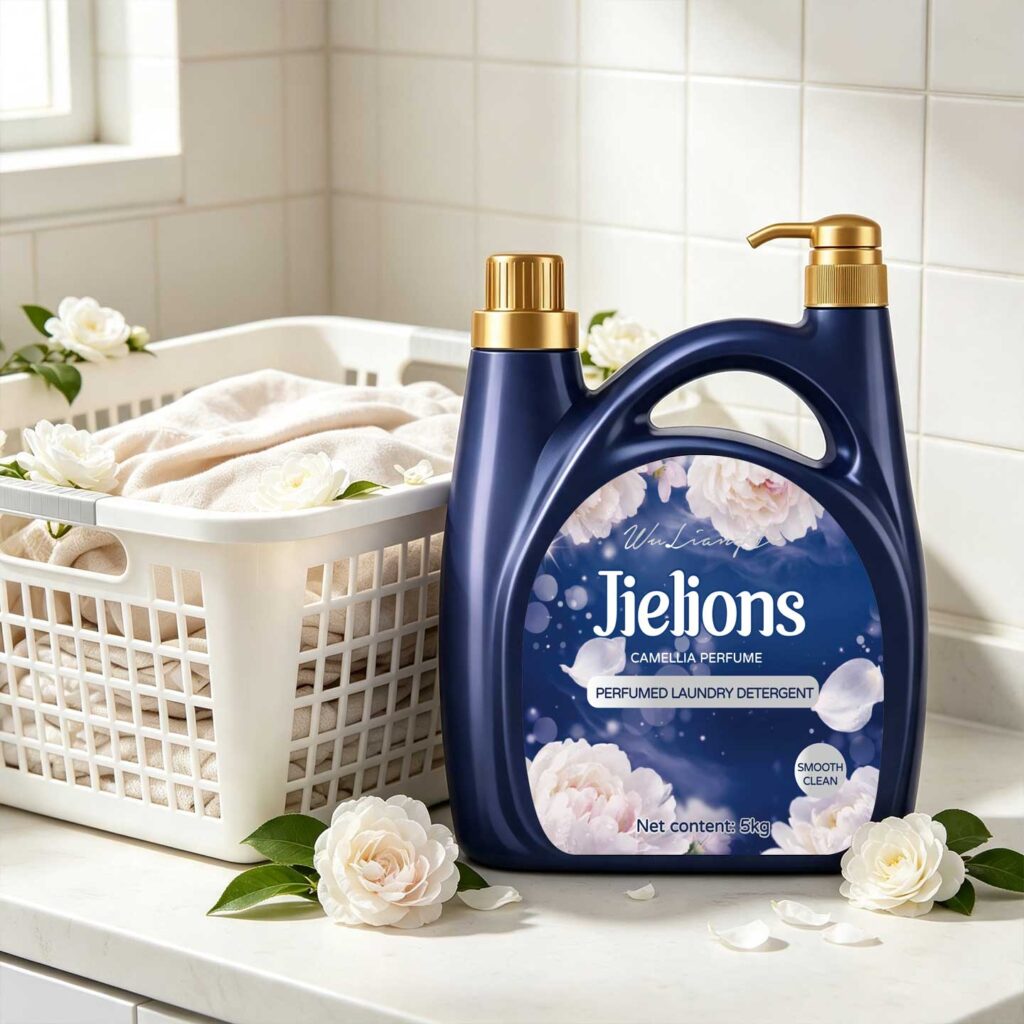
The Camellia name includes “Perfume Laundry Detergent”; “White tea flower or customization” appears in the fragrance field. If you were hoping for an unscented wash, those entries would be a reason to enquire further, not a reason to assume the scent has been left out.
With a custom order, an approved sample reference can identify the scent you chose. Keep any ingredient enquiry alongside that reference. The reference says which sample you mean; the supplier’s product information answers what you need to know about it.
Fabric care and skin claims aren’t interchangeable
Imagine a draft label that takes an ingredient exclusion and adds “hypoallergenic” beneath it. What supplied the evidence for that second line? The exclusion alone couldn’t do so. A claim about suitability for babies would raise the same question.
In Camellia’s title, “gentle” describes fabric care. There’s no reason to turn that phrase into a skin-test result. For an ingredient-avoidance brief, provide the actual requirement and ask about the complete version being proposed. “Gentle” on its own is too open to interpretation to replace that discussion.
What about the phosphorus wording beside it?
“No Phosphorus” and “No Fluorescent Agent” appear together here, but they’re separate statements. An enquiry covering both could number them as two requirements. The reply can then address each one, with neither disappearing into an ambiguous “yes, free from.”
The distinction matters when editing a retail description too. Shortening the pair into “free of harmful chemicals” introduces a different claim. The new sentence would need an explanation and evidence of its own. Why introduce that problem when the specific, confirmed exclusions are what the buyer asked about?
Where does cleaning performance enter the decision?
You might shortlist a bottle from the liquid laundry detergent range because its ingredients meet your brief. Before buying, there’s the practical matter of the laundry you intend to use it on. Read the garment care information and the directions for that bottle, including the dose. A previous detergent’s routine may be familiar, but it doesn’t supply the new one’s instructions.
For a sample review, a useful question might be: “Did the mark we were concerned about come out in this wash?” Record that answer separately from your impressions of the garment’s general appearance or scent. These are suggested review questions, not Camellia test results. They make feedback more useful than a single “we liked it.”
The public specification gives 5kg net content and describes cleaning and fabric-care functions. It doesn’t turn the exclusion statement into a measured performance result. Product information and evaluation of the proposed version still belong in the buying decision.
What can a private label buyer ask Jielions for?
A stock sample can be the beginning of a project without being its final formula. If a change is agreed later, check that the exclusion confirmation still concerns the version you’re ordering. Record which version any declaration or test document covers before using it to approve label copy.
Behind the Camellia offer is Guangdong Jieshi Biotechnology Co., Ltd., based in Foshan, Guangdong. Jielions is its brand for a business developing and manufacturing laundry and personal-care products. A project can involve formula development and packaging customization; quality inspection covers materials through finished products, with the confirmed sample as a reference.
The OEM and ODM process includes sample evaluation and packaging design guidance. You could open with a request for Camellia information against your ingredient brief, followed by a sample and a proposal for the intended pack. Tell the supplier which market and label wording you’re considering. Once the version is settled, request a quotation against it.
Conclusion
Choosing around an ingredient preference doesn’t require a broader promise about the product. With Camellia, ask for confirmation against the fluorescent-agent requirement, then consider the fragrance and directions. For label copy, carry through the answers for the version you approved. That keeps “free from” attached to an identified ingredient category rather than turning it into an undefined assurance.
FAQs
Can I compare cleaning results from this statement alone?
No cleaning score is supplied by the statement. The wash result on the items you’re evaluating is a separate part of the product review.
Is there fragrance information beyond the product name?
Look at the specification’s fragrance field: it reads “White tea flower or customization.” This is a perfume-detergent listing, not confirmation of an unscented formula.
Can “no fluorescent agent” support a hypoallergenic label claim?
Not on its own. The second claim would need evidence about the complete product, beyond that one ingredient exclusion.